

Competitive gaming has evolved far beyond simple entertainment. In modern titles like Counter-Strike 2 (CS2), success depends on strategy, precision, adaptability, and informed decision-making. One of the most overlooked aspects of this competitive environment is the importance of loadout selection. While choosing weapons and equipment may appear straightforward, the process closely mirrors the principles of scientific thinking and educational problem-solving. Every CS2 loadout decision requires players to test variables, analyze outcomes, and refine strategies based on evidence.
In many ways, competitive gaming reflects the same logical framework found in scientific learning, where experimentation and observation drive continuous improvement.
The Scientific Method behind Loadout Selection
At the core of science lies the scientific method, forming a hypothesis, testing variables, observing results, and adjusting conclusions based on evidence. Interestingly, CS2 players follow a very similar process when optimizing loadouts.
A player may begin with a simple hypothesis, a particular weapon setup might perform better in close-range combat. To test this, they use the setup during multiple rounds and observe performance metrics such as accuracy, kill efficiency, movement speed, and survival rate. This process involves repeated experimentation with factors such as:
- Weapon recoil control
- Damage output at different distances
- Reload speed and fire rate
- Economy management and purchase timing
- Utility usage such as grenades and flashbangs
If the chosen setup proves ineffective, players refine their strategy and test a different combination. This cycle mirrors laboratory experimentation, where results guide future decisions rather than assumptions.
Data Analysis and Performance Evaluation
Scientific learning depends heavily on data collection and objective analysis. Competitive CS2 players apply this same principle by constantly evaluating performance data to improve gameplay decisions. Players analyze measurable outcomes including:
- Accuracy percentages
- Headshot ratios
- Win rates using specific weapons
- Damage dealt per round
- Positioning effectiveness on different maps
For example, a player may notice consistently weaker performance when using one rifle compared to another. Rather than relying on personal preference, they evaluate the available data and adjust their loadout accordingly.
This resembles educational environments where students test theories, gather evidence, and revise conclusions based on measurable results. The emphasis shifts from guessing to evidence-based decision-making, reinforcing analytical thinking skills. Gaming, in this context, becomes an interactive lesson in applied data interpretation.
Controlled Experimentation in Competitive Environments
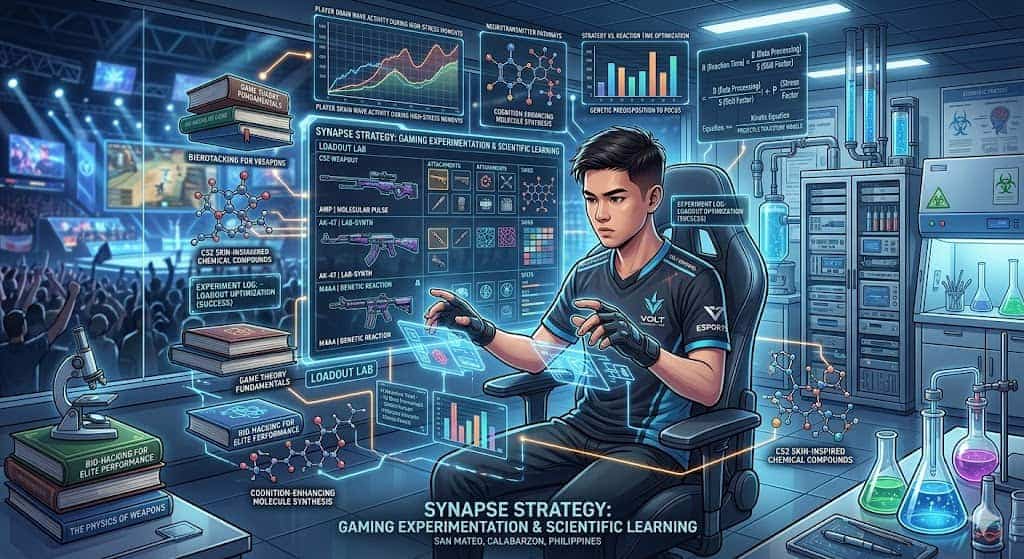
Scientific experiments work best when variables are isolated and tested under controlled conditions. Competitive CS2 gameplay often encourages players to do exactly this.
Rather than changing multiple factors at once, experienced players frequently test one variable at a time. For instance, they may keep the same weapon but adjust only movement patterns or utility timing to determine which factor influences performance most. Controlled experimentation in CS2 often involves:
- Testing different weapons on the same map
- Comparing aim performance with different sensitivity settings
- Evaluating economic strategies across multiple rounds
- Practicing recoil control under identical conditions
This structured testing process strengthens logical reasoning skills. Players learn to identify cause-and-effect relationships, a fundamental principle in both science education and critical thinking development.
The process teaches that improvement comes through systematic testing rather than random trial and error.
Adaptation and Hypothesis Revision
One of the most important principles in science is recognizing when a theory no longer fits the evidence. Scientists must revise hypotheses when new information changes the understanding of a problem. Competitive gaming requires the same flexibility.
In CS2, no loadout works perfectly in every situation. A strategy that succeeds on one map may fail entirely on another. Opponent behavior, team coordination, and tactical adjustments constantly change the environment. As a result, players must continuously adapt by asking questions such as:
- Is this weapon effective against aggressive opponents?
- Does this loadout work better for defensive positioning?
- Should utility purchases change based on team economy?
This constant reevaluation encourages intellectual flexibility. Players learn that successful strategies are rarely permanent and must evolve when circumstances change.
This mindset closely resembles scientific inquiry, where adaptability is essential for progress and discovery.
Gaming as an Educational Tool for Strategic Thinking
Competitive games like CS2 demonstrate how digital environments can teach valuable cognitive skills beyond entertainment. Through loadout experimentation, players naturally develop:
- Critical thinking and logical reasoning
- Pattern recognition and probability awareness
- Strategic planning under pressure
- Decision-making based on evidence
- Continuous learning through feedback
These are the same skills emphasized in science and education systems worldwide.
While players may not consciously think about scientific methodology during gameplay, the mental processes involved strongly reflect structured learning principles.
CS2 therefore becomes more than a competitive shooter. It serves as an environment where strategy, experimentation, and analysis combine to reinforce real-world problem-solving skills.
CS2 Loadouts are the Gateway to Analytical Thinking
At first glance, CS2 loadouts may seem like simple weapon choices based on personal preference. In reality, they represent a sophisticated process of experimentation, observation, and strategic adaptation that closely resembles scientific thinking.
Players continuously test variables, analyze data, revise strategies, and adapt to changing conditions in ways remarkably similar to the scientific method used in research and education. This demonstrates how competitive gaming can function as a powerful exercise in logical reasoning and evidence-based decision-making.