

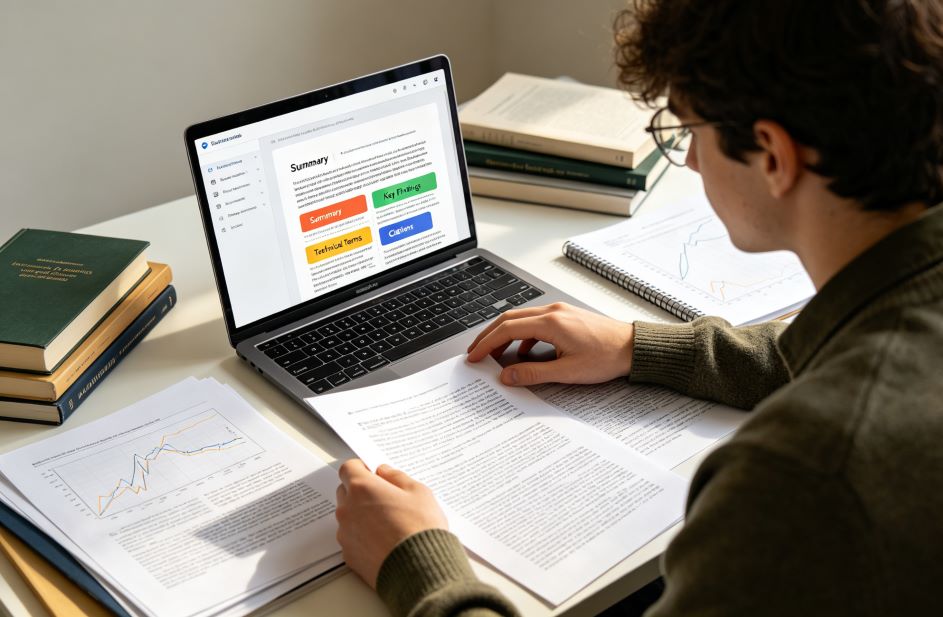
More than three million new scholarly articles are published around the world every year, creating an enormous volume of research for students and academics to navigate. UNESCO and the International Association of Scientific, Technical and Medical Publishers (STM) have both highlighted the rapid growth of scientific publishing, making it increasingly difficult for readers to keep pace with new findings. As academic literature expands, many learners struggle to read long research papers, interpret technical language, and determine which studies are most relevant to their work.
These challenges have encouraged the development of AI-powered tools that help readers process complex documents more efficiently. Platforms such as PDF analyzer AI provide one example of how document analysis technology can assist users in reviewing lengthy academic PDFs. Rather than replacing careful reading, these systems help organize information, summarize major sections, and identify important findings, allowing students to spend more time evaluating evidence and understanding scientific ideas.
The Challenge of Reading Scientific Papers
Scientific papers are written for precision. Researchers often use specialized terminology, detailed statistical methods, and structured reporting standards that can overwhelm readers who are new to a subject. Even graduate students frequently need extra time to understand unfamiliar concepts before they can evaluate the quality of a study.
The National Institutes of Health (NIH) notes that scientific literacy depends on understanding research methods, interpreting evidence, and recognizing limitations. These skills require practice, yet many students first encounter research papers with limited experience in academic reading.
Time creates another obstacle. A single research paper may exceed 20 pages, including references, data tables, and supplementary material. Students completing literature reviews often need to examine dozens of papers within limited deadlines. Reading every article line by line becomes difficult, especially when many papers ultimately prove unrelated to the research question.
How AI Is Supporting Academic Reading
Artificial intelligence has introduced new ways to organize and interpret large documents. Modern document analysis systems use natural language processing to identify important topics, summarize sections, and highlight relationships between concepts.
Instead of manually searching through every page, readers can quickly locate information about research objectives, experimental methods, sample sizes, or conclusions. This makes early-stage literature review more efficient without changing the original scientific content.
Stanford University’s Human-Centered Artificial Intelligence (HAI) has observed that AI tools increasingly support knowledge work by helping users manage growing volumes of information rather than replacing human expertise. This reflects how many students now approach academic reading, using technology to organize information before conducting deeper analysis.
Breaking Down Technical Language
Scientific writing often includes terminology that varies across disciplines. Biology, engineering, medicine, economics, and computer science each use specialized vocabulary that may be unfamiliar outside those fields.
AI-based research assistants can explain difficult terms using simpler language while preserving their scientific meaning. Instead of searching multiple dictionaries or textbooks, students can receive plain-language explanations that improve comprehension.
This approach is especially valuable for interdisciplinary learning. A public health student reading genetics research, for example, may understand the overall findings more quickly after technical concepts are clarified through intelligent document interpretation.
Even experienced researchers benefit when reading outside their primary areas of expertise. Simplified explanations reduce the initial learning curve while encouraging readers to continue exploring unfamiliar topics.
Helping Students Focus on Key Findings
Many scientific papers follow similar structures, including an abstract, introduction, methods, results, discussion, and conclusion. Although this format supports consistency, locating the most useful information still takes time.
AI document reading tools can identify major findings, summarize research questions, and outline experimental results. Readers gain a clearer overview before examining detailed evidence.
Research published by Nature has emphasized the growing importance of computational tools in helping scientists manage expanding research output. Efficient organization allows researchers to dedicate more attention to evaluating scientific quality rather than simply locating information.
Students preparing assignments also benefit from faster identification of relevant sections. Instead of repeatedly scrolling through lengthy PDFs, they can navigate directly to discussions that address their research topics.
Supporting Literature Reviews
Literature reviews require comparing multiple studies, identifying patterns, and recognizing conflicting evidence. This process often demands careful reading across dozens of publications.
AI-assisted PDF readers help organize themes across documents by highlighting recurring concepts, identifying similar keywords, and grouping related findings. These features make it easier to compare studies while maintaining the original context of each paper.
Despite these advantages, students still need to verify every summary against the original source. Context matters, especially when interpreting statistical significance, research limitations, or nuanced conclusions.
Experts from the American Psychological Association (APA) continue to encourage careful evaluation of original research, emphasizing that critical reading remains essential regardless of technological assistance.
The Educational Benefits
When used thoughtfully, AI-powered research assistants offer several educational advantages.
- They reduce the time required to locate relevant information within lengthy PDFs.
- They improve accessibility for readers encountering unfamiliar scientific vocabulary.
- They help students organize notes during literature reviews.
- They encourage broader exploration of research by lowering the initial barrier to entry.
- They allow learners to spend more time analyzing evidence instead of searching for it.
These benefits can improve confidence, especially for undergraduate students beginning their first research projects. Faster access to key information often reduces frustration while encouraging deeper engagement with scientific literature.
Understanding the Limitations
Despite impressive progress, AI remains an assistant rather than a replacement for scholarly reading.
Automatic summaries may occasionally omit important context or oversimplify complex findings. Statistical methods, research limitations, and subtle interpretations still require careful human judgment. A brief summary cannot fully capture every detail contained within a scientific publication.
Bias is another consideration. AI systems learn from existing data and may produce incomplete or imperfect interpretations. For that reason, universities continue encouraging students to verify information against original sources before citing research.
UNESCO’s Recommendation on the Ethics of Artificial Intelligence emphasizes transparency, human oversight, and responsible use of AI across education. These principles reinforce the importance of combining technological assistance with independent critical thinking.
Balancing AI Assistance With Critical Thinking
The strongest learning outcomes come from combining AI tools with traditional academic skills. Students still need to evaluate research quality, identify possible bias, understand study design, and assess whether conclusions are supported by evidence.
Document analysis software can accelerate information gathering, but it cannot replace curiosity, skepticism, or scientific reasoning. Careful readers continue asking important questions. Was the sample large enough? Were the methods appropriate? Do other studies support the findings?
Answering these questions requires thoughtful analysis that extends beyond any automated summary.
Looking Ahead
Scientific publishing will likely continue expanding as research becomes more global and interdisciplinary. Students, educators, and researchers will increasingly rely on intelligent document processing, AI research assistants, and academic PDF analysis tools to navigate this growing body of knowledge.
Even as these technologies become more capable, meaningful learning will continue to depend on careful reading, critical evaluation, and thoughtful discussion. AI can reduce repetitive tasks and improve access to information, yet understanding science still requires human judgment. Used responsibly, document intelligence solutions can become valuable educational partners that help readers spend less time searching and more time learning from the evidence itself.