

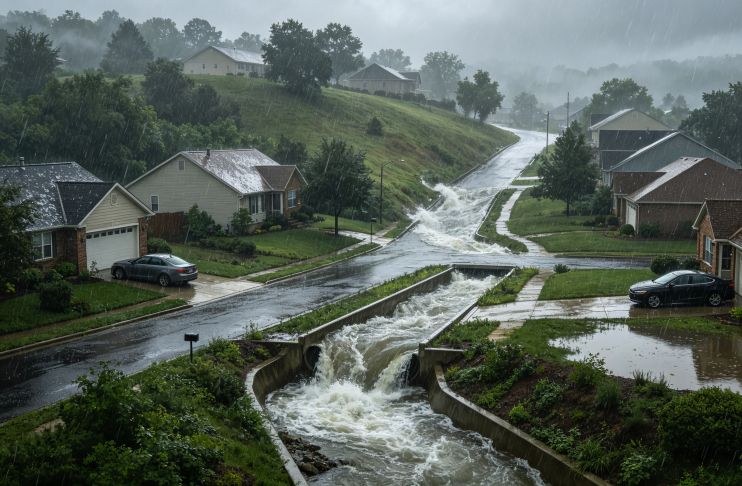
Atlanta receives more rain in a typical year than Seattle does. Climate data compiled by bestplaces.net shows Atlanta averaging around 51.5 inches of rain annually, compared to roughly 38 inches for Seattle. The gap surprises many people, since Seattle’s reputation for gray, drizzly weather is so well known. But Seattle’s rain comes in light, frequent doses. Atlanta’s comes in fewer days with far heavier downpours, the kind that overwhelm drainage systems in a matter of minutes.
That distinction matters more in Atlanta than almost anywhere else, because of what sits beneath the city. Atlanta was built on the Piedmont region’s dense red clay, a soil type that resists water instead of absorbing it. When intense storms move through, the ground cannot keep up, and water pools around houses faster than it can drain away. Homeowners dealing with the aftermath often turn to services for flood and water damage restoration Atlanta providers offer, since heavy rainfall paired with poor natural drainage tends to hit foundations and basements hardest.
A Rainfall Pattern Built for Sudden Overload
Seattle’s rain earns its reputation for a different reason than most people assume. Reporting from The Weather Channel notes that Seattle sees measurable precipitation on roughly 152 days a year, but most of it falls as light drizzle. Atlanta’s pattern runs the opposite way. It sees fewer wet days overall, but a much larger share of its yearly total arrives during intense summer thunderstorms, with July alone regularly bringing more than five inches, according to climate data from bestplaces.net.
Storms of that intensity generate what hydrologists call flashy runoff. Rain falls faster than the ground can absorb it, so it moves across the surface instead of soaking downward. Research published by the National Weather Service examining flood patterns across Georgia found that the Atlanta metro area consistently ranks among the most flood-prone zones in the state, driven largely by short, high-intensity rain events on already saturated ground.
Clay Soil That Was Never Built to Drain
The second half of the equation lies underground. Metro Atlanta sits on Piedmont red clay, formed from decomposed granite and other crystalline rock. Its particles are extremely fine and packed tightly together, leaving little room for water to pass through. The U.S. Department of Agriculture’s Natural Resources Conservation Service classifies clay soils with this structure as Hydrologic Soil Group D, its lowest infiltration category, reserved for soils that generate the highest amount of surface runoff during storms.
Field research conducted at the Georgia Institute of Technology on infiltration rates across the Piedmont physiographic region backs this up, showing that fine-grained soils here transmit water far more slowly than the sandy or loamy soils common elsewhere. A heavy rain event in Atlanta behaves less like water soaking into a sponge and more like water running off a sealed driveway.
Why the Water Ends Up at the Foundation
Slow infiltration alone would be a problem. Combined with Atlanta’s terrain, it becomes a bigger one. The city sits across rolling hills rather than flat ground, and grading around many residential lots slopes toward the house rather than away from it. A hydrologist quoted in coverage of a 2026 flash flood event affecting several metro counties explained that Atlanta’s hilly topography channels rainfall downhill quickly, concentrating it in low-lying areas and straining drainage systems designed decades before current storm intensities became common.
When that runoff reaches a home, the clay around the foundation absorbs what little it can and holds onto the rest. As the clay saturates, it swells, a behavior known as shrink-swell expansion. That swelling pushes against basement walls and slab foundations, building hydrostatic pressure that can force water through small cracks in a foundation wall. Analysis from foundation repair specialists at AquaGuard Foundation Solutions describes this cycle as one of the more common drivers of foundation cracking and bowing across Georgia homes, particularly on graded or filled lots where the natural soil structure has already been disturbed.
A Combination With a Long Track Record
The risk is not theoretical. The National Weather Service office serving Atlanta has documented that the September 2009 flood event, among the most damaging in the region’s history, brought more than 20 inches of rain to parts of Douglas County in under 24 hours and caused major damage to nearly 17,000 residences across the metro area. That storm was extreme, but it showed how quickly the region’s soil and topography can turn intense rainfall into structural damage once drainage capacity is exceeded. More recent flash flood warnings across multiple metro counties this year point to the same pattern repeating on a smaller scale most storm seasons.
Looking Ahead
None of this means every heavy rainstorm will lead to flooding, but it does explain why Atlanta homeowners face this risk more consistently than residents of cities with reputations for being far rainier. As weather patterns trend toward fewer, more intense storms, and as continued development adds more paved surface across the metro area, pressure on aging stormwater systems and clay-heavy lots is likely to grow rather than ease. Understanding how rainfall intensity and soil behavior interact is a useful starting point for grading property correctly, maintaining drainage systems, and catching warning signs before water reaches the foundation. Once water does get in, prompt cleanup matters just as much as prevention, since damp drywall and carpeting can grow mold within days, making the health benefits of a clean, mold-free home just as relevant to flood recovery as the repairs themselves.